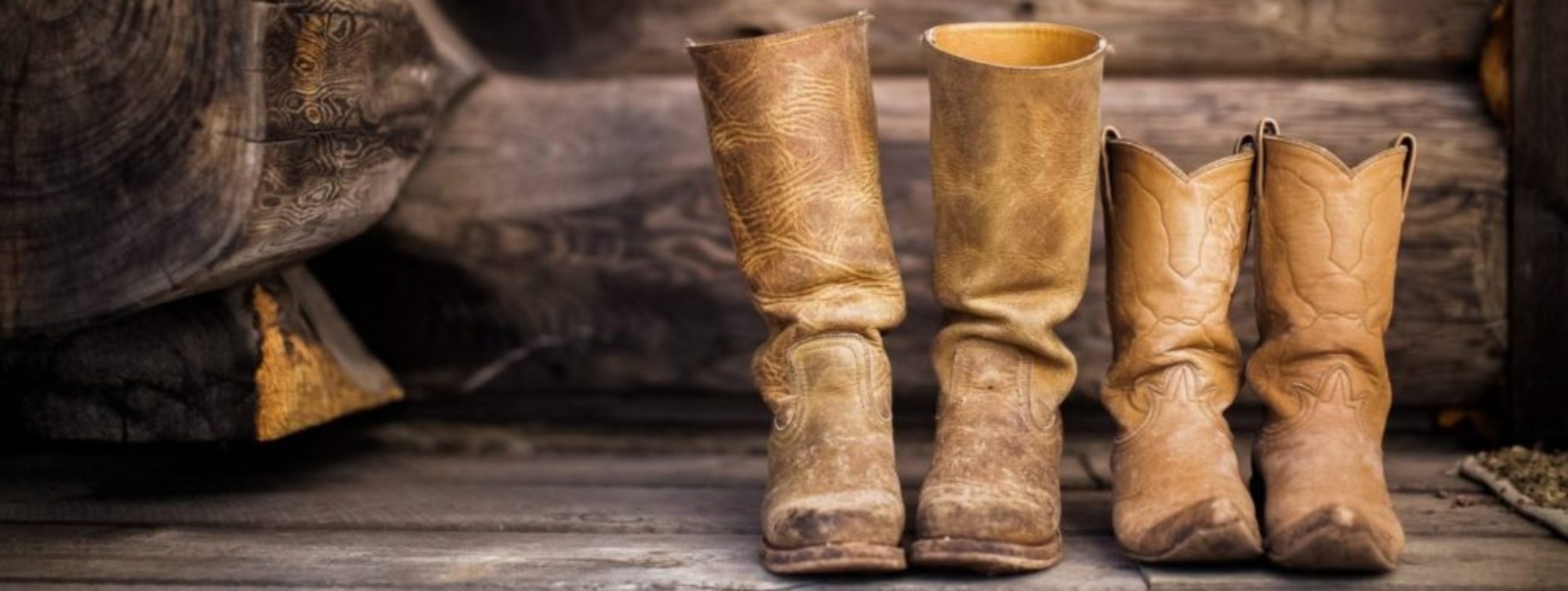
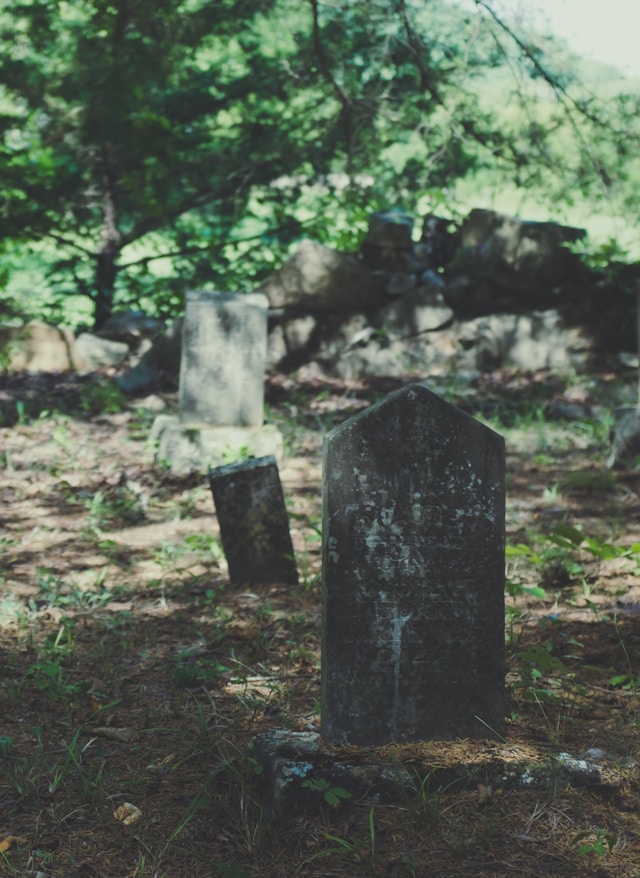
Hatty Sternberger poured the last spade full of dirt onto her husband Randall’s grave. She hadn’t yet bought a headstone with an engraving. The local Salinas men who volunteered to lower the casket into the ground had all left, and Hatty was on her own with her two children, Samuel and Patricia, and her younger sister, Deborah. Her bible was still open. Remember that you are dust, and to dust you shall return. She never could find that part in the scripture. She hammered a cross in the dirty pile, which protruded from the earth like a man’s full belly after a meal.
“I might have to kill Jorgensen,” Hatty said to her sister.
“You can’t do that,” Deborah said, almost yelling.
“Why not?” Hatty fired back.
They walked through the dirt patch where they buried Randall. As they neared the house, they passed through fields of lettuce, cabbage, and potatoes. In the distance, they could see the cross sitting atop the grave.
“The Sheriff, the judge, everyone would know it was you that did it,” Deborah said. “After they refused to put Jorgensen in jail, they’d know it was you for sure.”
“Still…I’m thinkin’ about it,” Hatty said.
Night fell, and they all sat down for dinner at a long wooden table that Randall had built himself. They left the seat at the head of the table vacant. Hatty passed the corn to her sister.
“Patty, make sure you eat some corn,” Hatty said to her daughter.
Patricia looked at her brother.
“When’s daddy coming back?” Samuel said, staring at the corn.
“Daddy’s not comin’ back, baby,” Hatty said.
Hatty, too, missed Randall already, and his voice played in her head–Ye need to know how to do things in case somethin’ happens to me. The thought of Randall not being around scared and confused her. His soldiering in the Union army during the Civil War proved an asset. Before he was killed, he began teaching Hatty about horses and shooting and how to use different kinds of knives.
Before Randall and Hatty moved to Salinas, Randall recognized Jorgensen one day while they lived in Monterey. Years had passed since Randall last saw Alexander Jorgensen on Harald’s ranch in Yuma. Randall cursed to God through his teeth as to why they’d been brought together again. It prompted him to tell Hatty the story of how Jorgensen came into an ill-gotten sum of gold.
Jorgensen was a hardened man, and I knew it when I looked in his eyes. There was no life in them. They were stone, and the man was stone too.
You were so sure about him?
He seen war somewhere. I know it. Carried a pistol, too. Most men did, but there was somethin’ about him carryin’ one that was different.”
During the latter years of the gold rush, Mr. Harald Sternberger, a Prussian immigrant, purchased Randall from a Southern planter to assist him in his prospecting in California. Harald was successful with Randall’s help, and they settled in Yuma, Arizona, where he ran a ranch. The land eventually became Confederate Arizona, and when the war broke out, Randall went off to fight in the Union army. When he returned to Harald Sternberger’s ranch after the war, Harald hired Jorgensen, a ranch hand who’d recently emigrated from Denmark after the Second Schleswig War.
While working for Harald, Randall saw that any abrupt movement by the horses frightened Jorgensen, and that was what cemented his opinions. Cows were slow and had no effect. Randall tried to keep him working with the cows. He always gravitated towards the horses that needed breaking. It seemed to set off something wild in him. He survived a kick from one of them. Randall was amazed at the sight. A man that wouldn’t die, he thought. Maybe he couldn’t.
When Harald’s mother took ill, he traveled to say goodbye to her. He was gone for several weeks, and on the day he returned home, he entered the house to find Jorgensen going through his things while Randall was out with the horses. Jorgensen managed to find a small deposit box with pieces of gold.
Was that what you came for all along?
Jorgensen’s hand was faster than a light switch. The pistol’s hammer was cocked and released, hitting the back of the bullet primer, and Harald Sternberger’s body dropped. He lay on his bedroom floor, his shirt stained with blood. Randall sprinted toward the house after the shot rang. When he entered to see the body on the floor and Jorgensen standing over it, he ran towards him. Jorgensen’s quick hand cocked and fired dry. His only bullet left in the cylinder was spent on Harald. The two men tussled until Jorgensen grabbed hold of the .22 caliber pistol Harald Sternberger had been carrying on his person for his trip. Randall ran out of the house, escaping the three shots Jorgensen let off. Jorgensen disappeared with the gold he was able to find. Harald’s Will stipulated that the house be left to Randall. Given the tragic event, Randall sold the house and moved to Monterey, where he met Hatty. It was also in Monterey that Randall saw Jorgensen again.
“People fear that man,” he said to Hatty. “He quiet and stern with most folks. They don’t know what he’s like. Not like I know.”
They both saddled onto the single horse and looked at Jorgensen who was walking toward his house from the saloon with his back turned. Some of the Monterey locals couldn’t help but stare at the couple atop the horse.
“We’re always afraid of what we don’t know,” she said, holding onto his waist.
“Or when white men are quiet and have a lot of money,” he said.
“You ain’t makin’ a lot of sense,” she waved.
“Let me tell it,” he said.
“Isaiah 54:17. You remember that one?” she asked.
“I think we can agree on that one.
“Good, I like it. Since we married, you should like it too.”
Randall smiled.
“You ain’t forgave him, have ye?” she asked.
“God’ll deal with him. It won’t be me.”
Matthew 6:15 came to mind, but she didn’t say anything. She knew he knew the Bible well, too, and she didn’t want to make their conversation about Bible verses at that moment.
“What you think about movin’ out of Monterey?” he asked.
“Why would you want to do that?” she asked. “I thought you liked it here.”
“Just think it might be safer. If Jorgensen sees me or finds out that I’m here, it won’t be good for neither of us.”
She paused.
“I’ve heard folks talk about how nice it is in Salinas. We could go there.”
“We could start a ranch.”
“And have horses, and cows, and whatever else. We’d have enough space to grow corn and such, too.”
“That’s right.”
“You got money for a ranch?” she asked.
“I’ve got my money from the army, plus what old Harald left me,” he said.
“You know how to run a farm?” she joked.
“Woman, I know my way around ranches and farms, back to front, east to west,” he said, smiling at her over his shoulder.
“If you say so,” she said, smiling.
After Monterey, Hatty and Randall moved to the farmlands of Salinas. They visited a Monterey bank to help secure an old house and land where Hatty had Patricia and Samuel. They grew their own vegetables and had cows, chickens, and some sheep, as planned. The house had three rooms, each relatively small, but the space was enough for all of them. It looked and smelled of unfinished wood, having been built not many years before they moved in. She never asked how Randall had the money to buy these things. She just thought that the army paid well enough for him to build a life.
On a foggy morning, Randall made a trip to the bank in Monterey. Jorgensen caught sight of him coming out of the bank, and they both froze—four boot heels stopped in the California dust. They locked eyes. Randall thought of everything he’d been through to get to that point. The midday sun beat down on them on that summer day. Once a slave, gold digger, cowboy, husband, homeowner. He’d done a lot. In a flash, the town heard two shots fired at the same time, and Randall Sternberger fell to the ground, and the dusty earth comforted him like it were a quilt. No one was willing to testify—a negro man shot dead outside of a bank. The sheriff was the one to tell Hatty, saying several times that Randall fired first. That was the way the sheriff wanted to tell it, and no one protested. No one wanted any involvement, and one less negro, the better for them. Hatty was the last person Randall saw as things faded to black for him. She imagined him lying there, and she desperately wished she could have held him in her arms while he passed, no matter how bad the thought of it was.
Hatty put her children to bed and went to her sister’s room to see that she was already asleep. She went to her room and pulled out Randall’s lever action Winchester long rifle. Need to know about the different kinds of Indians out there too. They not all the same. Shouldn’t treat ‘em all the same. She tried to be quiet as she rummaged around for bullets. She found a box and fed bullets into the loading port, then grabbed a box of extra bullets. She put everything into a bag and slept for a few hours—long enough for it to still be dark when she awoke. Fog descended on the land, and she put on a jacket, loaded up on their horse, and rode to Monterey.
She stopped at about the halfway point to rest, building a fire to stay warm during the chilly night. When she awoke, the chunks of firewood were white and gently blew in the wind. A native man stood over her as if he’d been watching her sleep for some time. She tried to get up, but another young native man crouched down to put his arm around her neck and put a knife to her throat. She thrust one boot heel against one of the large rocks used for the campfire, and the young man’s head struck a large rock. The older man, now standing farther back, took out his knife. Hatty quickly removed Randall’s old rifle and fired. She pulled the lever out, and returned, ejecting the hot shell, and delivered another bullet. The second of the two landed. Her heart was beating rapidly. The younger man’s eyes were open, and he was not moving. She walked to the body of the older man, and his breaths were shallow, with his eyes quivering. He was looking up at the sky as if it would give him answers to ease the pain. His head slowly turned to her, eyes still quivering.
“I got no way of helpin’ ye,” she said to him. “Jesus God, I’m sorry.”
She knew he couldn’t understand her, but somewhere in the afterlife, she thought God would get her message to him. The blood from the gunshot wound leaked over the sides of his stomach, forming a small puddle. His eyes focused on the knife strapped to her belt. She pulled it out and knelt next to him, dragging herself closer and putting the blade to his smooth neck. He lifted it for her, and his hand followed to touch hers. Her hand began to shake. She thought of the minutes before when the young man had her hair in his hands, ready to end her life, and she thrust her knife into the old man’s neck and pulled the blade across. She stood up and looked at the life leave his body. The sun was still hidden in the mist, and she packed up her things with shaky hands and continued to Monterey.
She settled into a small inn near the town square. The innkeeper was a stout negro woman that kept a shotgun at her desk for visitors to see.
“Where’s ye husband?” the woman asked.
“He’s dead,” Hatty said.
The woman looked Hatty up and down—her dress, the bag slung over her shoulder- and leaned to the side to see her horse tied to the hitching post. She told her the cost and beckoned as she walked down the hall to the rooms. Inside, there was a small bed. She imagined Randall sleeping on a bed of similar size in the army barracks. There was one window with a see-through curtain over it. The floors were wood paneled and looked pale from wear. Hatty put her things down and returned to ask the innkeeper where Mr. Jorgensen lived, assuming he’d still been the known man he was. Hatty thought about how she would go over there. She could. She knew it. But she couldn’t just swing her rifle over her shoulder and knock on the door, stand back, and let Jorgensen have it. She left the rifle, wrapped in a quilt, and she left her revolver too, for she couldn’t carry it without anyone noticing. She took one of her knives and sheathed it, and took a lace from one of her shoes and put it through the belt loop of the sheath. She lifted her dress, tied the lace high on her thigh, and walked out of the inn. She crossed the town square and headed over to the Jorgensen house. It was a two-story house 30 paces from the town square. The sun came out, and the fog dissipated. She paused for a moment and looked around at all of the townspeople. No one suspected her while she walked, but the longer she stood there, unattended to, the more people stopped to stare at a negro woman standing alone. Of all places for a negro woman to be standing alone, she stood at the wrong house, in their eyes. She knocked on the door, and a woman answered. It was Daisy, Jorgensen’s caretaker.
“Mr. Jorgensen isn’t well at the moment, and he’s not taking visitors,” she said.
“What’s wrong with him?” Hatty asked.
“Mr. Jorgensen is ill.”
“May I see him?”
“And what business do you have with him?”
“I was his caretaker once,” she lied. “He was my owner.”
Daisy stepped aside and allowed Hatty in. Her heart was bouncing around in her chest like when she fired a gun for the first time. She was tired, but she couldn’t rest. She was shown the room where Jorgensen was lying in bed with his mouth and eyes closed. She examined the expensive curtains over the large window and the decorative bedding—long posts that framed the bed, like Jorgensen was in a king’s chamber. There was a chair, a dresser, and a stool that the helper probably used to feed Jorgensen. Hatty asked if they could be left alone. His eyes opened.
“It’s all right,” Jorgensen said.
Hatty shut the door quietly behind her and pulled a small stool next to the bed. She noticed a pitcher of water and a large King James Bible on the bedside table and realized that she’d forgotten hers on this journey. How could she? She thought to herself. In the midst of all her packing, she’d forgotten it.
“I’m not hiring any help,” he said. “I’ve already got somebody, as you can see.”
“I’m not here for that, sir,” Hatty said.
“Do I know you?” he asked.
“No,” she said.
He looked at her, then around the room, confusedly.
“Then what do you want, exactly? Speak plainly.”
“You killed my husband not long ago. I put him into the ground myself. Put the cross on his grave, and now I’m here for you. I rode all the way from Salinas just to sit right here next to you.”
“I don’t have any fear anymore since I found out that I’m dying, so you can’t frighten me with anything,” he said.
“Not even death?” Hatty asked, fixing her dress around her knees.
“I was a different man then,” he said. “Of that I am sure.”
Jorgensen sat up in the bed as Hatty put her boot on the stool. She unsheathed the knife and grabbed the chair by the dresser, wedging it underneath the door handle. Jorgensen’s eyelids crinkled, showing the crow’s feet in his face. She came back to the bed and sat on the stool again with the knife on her lap so that he could see it.
“You’re going to do this in my own house in broad daylight?”
She was shaking her head.
“I’m Randall Sternberger’s wife. He told me about you and how you came to get all of this. Those big windows, fine furniture in a big ole house,” she said. “That gold sure did get you a lot.”
He recoiled in the bed when she said Randall’s name and mentioned the gold. His neck quivered as he tried to swallow but couldn’t. He reached for the pitcher of water, but Hatty stopped him. She poured him a glass of water herself.
“You sit back,” she said.
She handed him the glass, and he drank like a stray dog in the Monterey summer heat. Drops of water escaped at the sides of his mouth.
“Do you have any idea what it’s like, burying the person you thought you were going to spend the rest of your life with?” Hatty asked.
“I never married,” Jorgensen said.
“Do you ever think about him? Not like I do, but because you killed him. Do you ever think about killin’ him the way you did? No punishment. Nothing.”
“I do,” he said. “It was something of a reflex. I admit I was scared to lose everything if people found out about my past.”
“And what about Harald Sternberger? Do you think about him?”
“I don’t. Not in the way I think about Randall. Old Harald was just a Prussian, and I’ve hated Prussians since I fought against them in the war.”
“Be that as it may, you’re a killer,” she said.
“And to you, that means that I deserve to be killed?” he asked. “I did things, those things, at a time in my life. And what do you know of me now, and what my life has been?”
She was silent.
“You’ve come to my home to kill me. Is that right?” he asked.
She nodded.
“You’ve been witness to nothing and only come with accounts from your husband,” he said.
“Who you killed. He did nothing to you but be there and exist. He wasn’t after you. He didn’t threaten you, and you gunned him down.”
There was a rattling and a thud at the door.
“Why is this door jammed? Are you all right in there, Mr. Jorgensen?” the woman asked.
“Yes, Daisy. I’m all right,” he yelled.
“You’re not afraid?” Hatty asked.
“God has been witness to everything I’ve done, and it is he I will have to answer to.”
He took a sip of the water. He’d calmed down, and no part of him was shaking anymore. Hatty still sat with her hands holding the knife in her lap. She could not resist an occasional glance at the bible on the bedside table. It plagued her to think that she forgot hers.
“I don’t know that anyone deserves to die. That isn’t for me to decide.”
“Whatever is in God’s plan. And, I suspect you to be a god-fearing woman,” he said.
She nodded.
“I do still think about Randall. We worked on the Sternberger ranch for some time. He was a good man. Did what he was told. Never gave any problems. I was in a rough time in my life, and he saw me do things I’m certainly not sorry for.”
Hatty could see the hate in Jorgensen’s eyes when he hinted at doing things in his past that he wasn’t sorry for. She supposed his hate for Harald Sternberger and Prussians was as bad as any white man’s hate for blacks in the deep south.
“It is a shame that I had to run into Randall again. I was afraid. That’s all. I really was afraid that he’d compromise the life I had right now.”
“I guess with Randall, you didn’t think about what killin’ him meant, what it would mean to the family he had. We have two children. He was a father and a husband. I bet you thought because he was a negro, that it didn’t matter that he’d be gone.”
“I didn’t think about it like that, I swear.”
“Well, whether you did or didn’t, that’s the way it looked.”
Daisy called again, and Jorgensen yelled again to tell her it was all right to leave them. Hatty pulled the chair away, and Jorgensen sunk into the bed as if he was ready to sleep.
“I am sorry. I want you to know that. I wish I could go back to that day and not have pulled my pistol.”
“But you can’t,” Hatty said.
He shook his head no.
“And that’s the part that doesn’t sit right with me,” she said.
She had nothing more to say, and she stared at the floor for a few minutes. She didn’t want to hear his voice either. The sound of him and his remorse irritated her. She could see Randall, as she remembered him, and their little spats when she threw bible verses at him when she felt like he talked a bit crazy. He would give his rebuttal verses until they were tired and silent. She always smirked when they went quiet. She would miss those moments when each of them, temporarily, thought they were right. At the same time, they know that neither was right, or they were both right. They were certain about who was always right and always witness to their love, their squabbles, and everything imperfect about them–God.
Hatty gripped the knife and stood up. Jorgensen’s eyes were closed, and she held her words again, just like she’d done so many times with Randall. She took her piece of lace and tied the knife up again. She showed herself out, and Daisy trailed behind, watching Hatty walk across the town square back to[1] the inn.
Alexander Miller began writing while attending Florida International University. He loves writing because it helps him further understand what it means to be human through research, creativity, and examination of himself and others. He currently lives in New Jersey and is working on his first novel, as well as a collection of short stories that are exclusively Westerns.