His head bent, his black Stetson nearly covering his eyes, Colby Hanson peered into the wheelbarrow as if looking for something inside it even though it was empty. Then, abruptly, he reared back and pushed it toward a kid not much older than his son, picking up speed with each step. Soon he was moving so quickly the front wheel began to rattle and shake. He was within a couple of feet of Lonnie when the kid jerked his head as if he were going to move right then went to his left, and immediately Colby smashed into his left kneecap.
“Damn, Colby!” the kid whined after he fell to the ground. “That hurt something fierce.”
“You’re lucky it was only a little red wagon that hooked you, son, and not some slobbering 1,500-pound Brahma.”
“Then your chili would’ve been cooked, all right,” Buck, another instructor at the rodeo school, chimed in with a slight grin.
Colby agreed. “Some of you gents may think you’re fast as lightning but, believe me, you can’t outrun an arena bull,” he told the nine students standing along the corral fence. “You can out maneuver a bull, though, but not with wimpy head or shoulder fakes. You have to sell the fake with your whole body. You have to really step into it. Lift up your leg like you’re climbing a ladder. Let the bull see your leg then pull it away. Otherwise you’ll end up on your backside like Lonnie just did.”
The young guy, stepping back against the fence, smiled weakly.
“Now who can I chase next?” Colby asked as he pushed the make-believe bull back to the center of the sandy corral.
A rawboned kid raised his hand and climbed down from the fence.
“Let’s do it then.”
And for the rest of the morning Colby chased one kid after another around the corral until their step fakes met his approval. They were at the school not to become bullriders but rodeo clowns, also known as bullfighters, whose main job is to protect fallen riders from being hooked or trampled on by the bulls they were riding. They did this by drawing attention to themselves and away from the riders. Manically they jumped up and down, made faces, shouted and laughed, waved red bandanas, ran around in circles, anything they could think of to distract the animal. Unlike circus clowns, they were often in considerable pain when they left the arena.
On the circuit for nearly seventeen years, Colby started teaching the bullfighting class only a couple of years ago when he was offered the position by one of the owners of the school, Elton Mathers, a retired bullrider he had protected scores of times from being freight-trained. At first, he declined, doubting if he could teach anyone anything. Certainly he had not succeeded with his son, Flynn, who never showed the slightest interest in learning about bullfighting. It was almost as if his son were embarrassed about what he did, though he never admitted it. But his lack of curiosity said enough. So Colby assumed if he couldn’t interest his son in his work, he wasn’t likely to interest anyone else. But Elton insisted he give it a try and he did because he could use the extra pocket money and, so far, found it more rewarding than he could have imagined.
*
“These young bucks are here because they want to put on greasepaint and face off with a bull,” Elton told him. “You don’t have to worry about motivating them. They have all the motivation in the world. What you have to do is show them what to do when they get in the arena and I guarantee you they’ll soak it up like maple syrup.”
“You want me to tell them about all the broken bones they’re going to get too?”
“You can if you want. It doesn’t matter to me, old stick, because I doubt if these kids much care. They’re here to fight bulls, and if some bones are broken, so be it.”
“Not as many as we’ve got, I hope.”
Elton nodded, tucking a nugget of tobacco in a corner of his mouth. “Just about everything that can be broken has been, hasn’t it?”
“That’s for sure.”
“Well, whether you tell them or not, it’s something they’ll learn right quick, one way or another.”
“I just hope not too quickly.”
“Oh, I don’t know, Colby. Maybe the quicker the better then they’ll know if they are cut out for this line of work.”
*
“Don’t forget, gents, part of the job of rodeo clowns is to entertain the crowd,” Colby reminded his students. “That’s why we paint our faces and wear funny clothes. So when you’re in the arena be happy and loose. Put a smile on folks’ faces. Glide around like you’re on skates.”
“Skates, sir?” one of the students asked quizzically.
At once, he bent his knees and stretched out his arms as if mounted on a skateboard. “Glide across the sand as if it were ice, gents.”
The student smiled at him, skeptically, just as his son did the time Colby mentioned, after watching him perform some intricate spins and jumps on his skateboard, that he was nimble enough to be a top notch clown some day.
“I’m not a funny person, Pop. You are but I’m not.”
That was when he realized Flynn had no intention of following him into the rodeo business so he was not really surprised when his son enlisted in the Army soon after he graduated from high school.
*
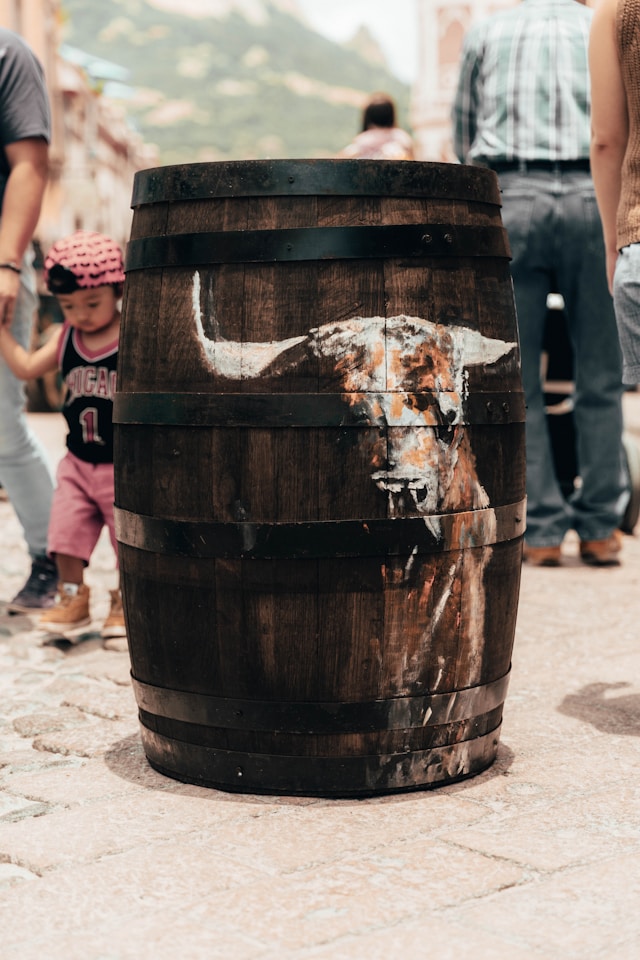
“This is not a trash can, gents, or a spittoon for bullriders,” Colby said, as he stepped behind the dented white aluminum barrel set up in the middle of the corral. “It is what the more educated in our fraternity call ‘a clown condominium.’”
A few of the students laughed at the ancient wisecrack.
Smiling, too, he climbed inside the 75-pound barrel and for a brief instant disappeared as he squeezed himself into it. Then he popped back up, and, lifting the barrel by the handles inside it, shuffled around the corral as if he were a show horse. He wanted to be sure all of the students had a good look at the rank cylinder.
“Believe it or not, gents, but this pickle barrel could well save you quite a few visits to the emergency room,” he said, after he climbed out of the contraption. “For sure, it will make your time fighting bulls a mite less painful and hectic. It really is your only protection in the arena. It’s where a clown can seek cover when he needs a moment to gather himself. Of course, as soon as he does, the bull usually comes after him and attacks the barrel, and he’s back running around as if his hair’s on fire.”
*
Late one afternoon, chopping carrots for the beef stew he was preparing for dinner that evening, Colby heard a car door slam shut outside his house then heard another one. Not expecting company, he parted a corner of the shade and peeked out the kitchen window. Stunned, he let go of the knife, which fell into the sink, and felt his knees give and almost fell himself but managed to grab the faucet. Two soldiers, in garrison caps and dress greens, walked up the flagstone path to his front door. They knocked three times, quickly and firmly, then waited for him to answer, but he remained absolutely still, as if his left hand were frozen to the faucet, and just stared at the drawn shade. Then they knocked three more times.
They could knock all day, as far as he was concerned. He knew what they wanted to tell him but he didn’t want to hear it. Not now, not ever.
You poor kid, he groaned under his breath. You thought you knew so much. You wouldn’t listen to what anyone told you. Not then, not ever.
*
Colby walked around and around the barrel, not saying a word as if he had forgotten his students were still in the corral. He always thought of himself as a bullfighter, not a barrelman, but like all rodeo clowns he had spent a good bit of time inside barrels during his career. They were too confining, though, drastically restricting his movement. Also, it was a lot more punishing inside a barrel, which many bulls attacked with incredible ferocity, sometimes kicking them end over end as if they were soup cans. His right arm had been broken three times while scrunched up inside a barrel and his left ankle twice. And he had been cut more times than he could count by bull sticking their horns into barrels. Once he nearly got his left eye poked out.
“Now, gents, I’d like to show you what it’s like to be a barrelman,” he announced, as if finally realizing he was still teaching a class. And very deliberately he removed his hat and set it on a post, looked at the bucking chute and climbed inside the barrel.
Some students smiled, expecting him to pop up a minute later with a bright red bulb on his nose or an orange wig, but he didn’t budge. No one did. Then, all of a sudden, the chute door opened and out charged a filthy red brindle bull with horns as sharp as spikes.
His teeth clenched so he didn’t bite through his tongue, Colby braced his knees against the thinly padded interior of the barrel and waited for the bull to attack. He didn’t have to wait long, either. Almost as soon as he drew another breath, the bull slammed into the back of the barrel, knocking it over on its side.
“Son of a bitch!” Colby cried, after banging his nose against a handle. And, at once, a thin stream of blood trickled across his lips. He tried to breathe through it but it hurt too much so he gulped for air like water.
The snorting bull kicked with its hind hooves, and the barrel started to roll and he banged his nose again.
“Son of a bitch!”
The longer you’re in a barrel, he knew from experience, the more likely you’ll get injured. So he hoped to spend the rest of the afternoon there, tumbling back and forth across the corral, the bull striking the barrel until he was sure his lungs had been turned inside out. Ever since he learned of his son’s death in some place he couldn’t find on any map he owned, he looked forward to climbing into a barrel whenever he could because the pain he felt there insulated him for a while from the worse pain he felt, at home, thinking about his son.
T.R. Healy was born and raised in the Pacific Northwest where he had fond memories of riding horses on the beach.