
A scuff mark. He noticed it on the inside of his right shoe.
He had dressed reflexively without putting on his glasses: boxers, black socks, white shirt, black suit, blue tie, Timex watch, ID badge. The right side of the closet, Cheryl’s side that he had gradually repossessed, contained three pairs of work shoes — all black — two wingtips and one regular lace up. He hadn’t noticed the scuff on the inside heel in the early morning darkness.
No way to fix this with another pair in his locker. Hell, he didn’t even have a locker. Replaced by a cardboard box with his employee number, J24m$03-sec in black marker. So he would have to walk over, maybe at lunch, and wait while what’s-his-name, always-wanting-to-talk-what’s-his-name, buffed.
Hey sport, he’d say. How’s it going? Why don’t ya take a few cards and just drop them off with the receptionists, the cute ones, in the office tower.
Did what’s-his-name not understand? Those upper floors, with the cute receptionists, it was another world. The lobby was as far as he got, as far as management let him go.
On the other hand, if he played along and took the cards maybe he could get a free shine. Every little dollar counts. His dad — even with the fat roll of twenties and hundreds hidden in a sock drawer, used to tell him that.
The train stuttered and slowed as it approached South Station. He strained to look out the window to where the Herald used to be printed, where the drivers would look at him and shake their heads saying, the spitting image of your dad, you are. The Herald, where they would give him a double sawbuck and a dozen papers to hawk and say, get me something at the all-night packie and put a good word in for me, with… you know, your dad. Let your dad know, a favor’s a favor. I’m good for the money.
And now a billboard proclaimed The Ink Block condos with a sales website. And the Gillette factory on the other side of the channel. Along with his first razor, Dad told him to always go with Gillette. The local brand, his dad used to call it. The paper said that place would go condo too.
He turned back to the inside obit pages in The Herald and indulged in his usual habit, using a green extra-fine point marker to underline the expected parts, the ways in which a person’s life went with the flow, gave into the usual. He used a red marker to underline the parts that might catch someone’s attention, stand out in the crowd.
She was the daughter of the late Naomi Salmian. Graduated from Wayland High School. She will be cremated by her great grandchildren and as was her wish, her ashes will be scattered on the waters off of Moonlight Beach in Encinitas California.
He was the beloved son of the late William T. and Andreana (Tornabene) Onetti. He graduated from Belmont High School in 1969 and received his B.S. in Education in 1975 at Northeastern University where he was on the Deans Student Advisory Committee. Bills ambition from childhood was to become a middle school teacher. However sadly, his dream was never realized. He instead chose to be a race car driver…
What was it that made a life notable? Race car driver. Did you need a year or a season? Was an afternoon or even a moment enough? Moonlight Beach. Was it something you did or could it be something that happened to you? Great grandchildren.
He felt in the top pocket of his shirt for his glasses and his building ID tethered, always tethered, to his lanyard that said, in white on blue lettering, Trust US.
Even if no one else, his boss for instance, noticed the scuff, still, take a little pride. Like his dad told him. Don’t forget, what you do is who you are. And when he asked his dad if that was true for him, his dad had said, Don’t be a wise-ass. I’m doin’, so you don’t have to. Let it go at that. He had tried to let it go at that. He had tried.
These days he hardly saw his boss, one of the kids – he thought of them all as kids – from the BMT, the Building Management Team. A fancy name for the guys in the lobby. The guys who blended in, who were part of the machine. The closest he got to his boss, on most days, was the shift coordinator, Enrique, who had been promoted up from maintenance at 100 State. That was after Jocko got fired. For what, nobody ever told him. One day Jocko was The Man, joking, telling people about the time when, and the next day, box removed, space reclaimed. Vanished. As if Jocko had been just taking up space.
If he had noticed in the darkness of the closet, he could have easily worn one of the wingtips. One of them needed new heels but it would have been OK for the day. These days he didn’t have to spend all that much time on his feet.
The train coasted forward and then jerked to a stop and men and women around him stood in the narrow center aisle waiting to exit. If he could get to the front door with any speed he might not be more than five minutes late.
A woman in pants was trying to take a small suitcase down from the rack above the seat behind him.
“Let me help you with that,” he said.
She gave him a wan smile, glancing over her shoulder.
“Oh, no…that’s OK. It would be harder for you than for me.”
He half smiled, noticing his reflection in the cracked train window, black overcoat, salt-and-pepper hair cut short and in place. There was a time when that choreography of help offered and help (always) accepted might lead to conversation, even, if you were lucky, a drink in town after work. Or just the acknowledgment of a friendly stranger, someone you could say hello to because you saw them every day without knowing whether they were a barkeep, a lawyer, a banker or a thief.
Looking at his own reflection he wondered what this women, what any woman, might assume about him. He wondered how long he could go into a shared drink before he would have to admit what he did. Maybe the truth just got in the way. Was that something his dad told him? Besides, without the truth, they could think they were out with anyone they wanted. Could he get through the first drink? What about the first date?
He remembered Jocko taking him to The Black Rose, a couple of months after Cheryl left. Fat Mike was behind the bar as always.
“Yeah, yeah,” Fat Mike almost a half-step ahead, always in on the scam. “It’s expensive, but it’s easy. On the one hand everyone, and I mean everyone, is out there. And you think, why not? But I tell you, you’ve gotta assume the women are liars too — at least as much as us, if not more — because they’re better at it.”
“For sure,” Jocko slugged half his beer, “When they tell you they’re a nurse — and everyone is a nurse; man, there must be a million nurses in this city — you have to assume they’re in rehab or they work the night shift at Dunks out past the swamp in Neponset.”
“Jocko,” Mike chimed in, “what does your profile say?”
“It says,” Jocko drained his glass and signaled for another, “I’m an engineering supervisor.” Jocko puffed himself out, “at the MBTA.”
“What the fuck is that?”
“I don’t know. But look, I ride the T. I can even name the stations, backwards and in order. Braintree, Quincy Center, Quincy Adams. Wait a minute, I’m too slammed for that. Doesn’t that count? Have you heard the jobs people have these days? Product evangelist. UX customer care designer. Single thread director for the circular economy.”
Those jobs made his head spin. “You guys are getting me drunk. Is that the plan?”
“Nah. I’m just saying. How come nobody drives a truck anymore?” Jocko swigs another. “Besides – we’ve got real jobs on the BMT.” Jocko hit his Trust US badge with a pointed finger and a laugh, “Like the badge says, do you Trust Us?”
He looked at Fat Mike for help and laughed.
“Exactly, brother,” Jocko’s finger poked him in the chest, “like I told you. But if you’re not on time, Monday, bright and early, I don’t care who your dad was, what you can trust is I’ll dock your pay.”
Fat Mike delivered Jocko’s next beer with a bang and a splash and casually mentioned, so everyone might hear, “if he docks your pay, I’ll charge him double.”
Fat Mike was like that since even before high school.
“Excuse me, are you getting off?”
Hearing the question brought him back into the train. The line to the front door had begun to shuffle forward and apparently he was in the way.
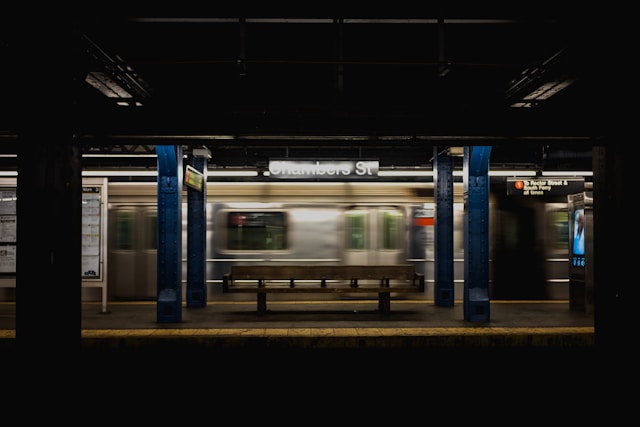
The weak winter sun was without warmth and the early morning cold of the platform came up through his shoes. Commuters hurried passed him to his right and left. The electronic flap display suspended within the arch of South Station marked the moment the train was here and the moment later when it was gone. Each train replaced silently by another and then another. He turned and looked up, a part of his morning routine, to notice if the morning express for New York and Washington would be on-time. The train he took with Cheryl. A great weekend together. Maybe their best.
Waiting for the pedestrian signal, he felt the cut of the harbor wind through his coat, blocked if only for a second by the others as they waited together to cross the Kennedy Greenway. He thought Matty in the Morning had said snow. It was certainly cold enough for snow. Early this year. Maybe just a dusting.
Enrique has told him to text if he was going to be late. Enrique’s been a prince, he told himself. He moved me to the front desk.Can’t ask for more.
Before that he was on security, posted in the lobby, making sure the ID machines worked, that no one jumped the machine and ran into one of the elevators. That was a job he had done for fifteen years, starting two or three months after 9/11. You had to be on your feet, watching, seven hours a day. Management said you were the first line of defense, carrying a house radio and a security key fob.
Although the lobby staff had drilled on it again and again, in those years someone had only jumped twice. Once a woman banker couldn’t get her ID to scan and slid past the machine. Jocko held up his hands, motioning her to stop. She looked right through him. Not even a nod. She was on her way up and he was, what, just a stone on the road? That must have pissed Jocko off. He took out his key fob, aimed it at her like a gun and slammed the elevators, freezing the entire building for 20 minutes. Everyone got mad. Her assistant called the management company and Jocko got reamed out. But everyone knew, like he said, he had just done his job. The other time, well, that was real. Some drunk lawyer yelling about the Constitution, looking for his girlfriend. Trapped in an elevator for over an hour, he peed himself and the BPD took him out in plastic wrist restraints.
“Hey pops.” Enrique had asked him. Just like that, out of the blue. “Your feet bothering you?”
In truth his feet were hurting him. At first he thought it was just the shoes. He asked about wearing a pair of black sneakers and some girl with sliced off hair, and she was a girl, probably no more than 25, from the BMT came down and said that wouldn’t set the right tone. If he needed, maybe put in for something else, go back to maintenance. She barely looked at him as she suggested maintenance and, feeling the heat rise in his chest he so much wanted to slap her but said instead, “That’s fine. Maybe a few days off.” He came in late that next morning having bought inserts for one pair of shoes. He kept a couple of Aleve in his pocket for when it really hurt and shifted his position from standing in front of the lobby gates to over near the wall where, in the late afternoons when no one was around, you could lean to take a little pressure off one foot and then the other.
“Pops,” Enrique said a few days later, “You can’t be standing for seven hours every day. Let me see what we can do.”
And it wasn’t bad, these past eighteen months on the desk. Most days there was a stream of visitors and vendors. He would call up and ask if they were expected and print their ID as they waited impatiently. Not really seeing him. Just seeing another thing standing in their way.
There was never-ending construction on High Street. A couple of guys in layers of sweatshirts, gloves and hard-hats were shoulder-deep in a hole, yelling to each other over the steady wompwompwomp of an air compressor. A woman in a safety vest held up the buses and trucks using Congress Street as the on ramp to I-93.
“Tough job on a day like this.”
She nodded and pointed at her ear guards. Women doing construction outside in the winter. Is this what they bargained for, fought for?
His dad had one of those construction jobs. When he got out of the Navy in ‘92, he asked his dad if he could arrange one and his dad had said, No son of mine is workin’ in a hole. Instead his dad arranged a maintenance job at one of the buildings downtown. It’s just a start, his dad said to him. You’ll probably get out of the neighborhood, which is where you want to be. You’ll get a place in the country. But don’t get too snobby. Don’t go all South Shore on us.
He never made it quite that far, but he did get out of the neighborhood. He just came back for boiled dinner Sunday nights. After his mom went all lala he had asked his dad if he wanted to move in with Cheryl and him. And his dad said, “and what would I do then, hmm, like a fish outta water? Who would I know out there in the country?” And then his dad got cancer and in just over a year he was gone as well. Just like that. A cardboard box filled with ashes in the back of the linen closet.
He remembered going over to The Black Rose, his first day back at work, maybe a week after his dad passed. He was standing at the bar, thinking, the world just goes on, doesn’t it? Somebody should notice something. Fat Mike must have noticed and quietly put a brew down in front of him saying, “You feeling sorry for yourself?”
“I’m trying to write his obit.” He looked over Mike’s head at the clock that never ran, the yellowed sports pages taped to the mirror, the bottles of booze that never emptied. “Just look out the window.”
“I haven’t looked out those windows in years. Can’t you tell?” They both laughed.
“This town’s a different place. I’m not sure he’d recognize it. I just want people to know he was special. I just want them to notice.”
Mike took a bottle of single malt from under the bar and poured them both a half a shot.
“When we were growing up people always said how much like him I was. And I wanted to be like him.”
“And?” Mike sipped the Scotch.
“I told him. And he just looked at me for a while and said, ‘Never going to happen. Never. You hear me?’ I think it was one of the only times he ever yelled at me.”
Mike put down his drink and leaned over the bar. “You only know half the story. Your dad got me this, you know?” pointing around the bar. “And there are half a dozen guys who come in here regular who would say the same.”
“I thought —“
“What you might not know is, your dad told me to keep you out of it. Even after he was gone. Your dad didn’t want you to have to do what he did. Or even think about what he did.”
“Was that the deal?”
“There was no deal. Your dad did what he did for you and for me and a bunch of people you’re never going to meet. That’s just who he was.”
“I don’t have the same juice he did. And I don’t have kids. Who am I going to do for?”
“Remains to be seen.” Mike took another sip of scotch. “Now show me what you’ve got.”
Mike took the page and read it over slowly.
“The stuff in red, you can’t put that stuff in here.”
“I’m just writing what other people said. Without it, he just seems like everybody or like no —“
“Stop right there, boyo.” Fat Mike grabbed his wrist and pulled him rough and close, halfway across the bar, spilling their drinks.
“The people that need to know, already know. If that gets printed, questions will be asked. And not by the right people. Remember what I promised your dad?”
“Yeah.”
“Keep it in mind.”
Mike let him go and reached back across the bar with his good hand and patted him on the cheek gentle as a dove.
“OK, then. Hey everybody, our friend here’s buyin’ — the good stuff. How about we lift our glasses to this gent’s dad, recently departed.”
And after the shots were filled for everyone with the same single malt from under the bar, bless Fat Mike, he went from one to another, clinking glasses. He could almost hear them thinking, the spitting image.
He submitted the boring version of the obituary, without the parts in red. But that’s when he started keeping score. Red pen. Green pen. Red pen. Green pen. What might be seen, what could be written, what would be noticed and remembered about anybody’s life? And what would left out or left over, just burned in a box?
Now some five years later he rocked on his heels to keep warm and waited for the traffic to pass. And when it did finally, before the light changed, he looked up at the steel gray sword of the building, One Post Office Square, before he crossed the street and slipped in through the glass doors.
He walked out across the polished gray cement of the lobby and hung up his coat in the inner room hidden behind the elevators. The cardboard box with his number had been moved and it took him more than a few minutes to find it. He checked his watch and then his hair in the mirror screwed into the back of the door. Enrique came in with Blaise, one of the rotating guards, in tow.
“I told you there might be extra shifts on weekends. I didn’t say for sure.”
“But I really – “
“Hey, pops,” Enrique asked him on an upbeat. “How you feeling this morning? Ready for another day?”
“Absolutely.”
“Blaise, can you give us the room for a minute.”
The door closed silently behind him.
“What’s his problem?”
“Doesn’t matter. Listen, pops, before you go out. I need to talk with you.”
“Ah, sure. The train was late this morning and I know you said I should text, but — ”
“What? Oh, don’t worry about that. I’ve wanted to mention… you seem, I don’t know how to say this, a little off, maybe a little tired these days.”
“Who said that?”
“I’ve been told, you know, that sometimes, in the middle of the afternoon, you seem to be less alert, maybe a little sleepy.”
“Don’t know what you mean.” He knew exactly what Enrique meant.
“Ah, you know -”
“I’m totally good when I’m out there.”
“Are you sure? Because some of the guys, and I don’t want to say who, have said you might be…coasting a little.”
“Enrique,” he leaned in. “Are you saying I’m dozing out there at the desk?” He thought the spitting image.
“I’m not saying that.” Enrique held up his hands to stop him from coming closer. “And it’s not something I’ve seen myself.”
“I’m paying attention. Believe me.”
“Management’s been on my case.” Enrique lowered his voice. “Said we could hire two or three temp guys with what they are paying you.”
“Yeah, I’ve been here more than fifteen years and now that Jocko’s gone, I’ve got seniority on everyone. It’s not something I planned. And I’m not taking advantage —”
Shit, he thought, when he came on, seniority was a good thing. When he came on there were guys who had worked for fifteen, even twenty years. And they were treated with the respect they deserved. Those guys, they called him “kid” and told him where to buy work clothes at a no-name place upstairs in the Combat Zone. They introduced him around. Nice guys. Real professionals.
“Just think about it.” Enrique took a paper out of the breast pocket of his suit and seemed to be looking for something else.
“I need to sign off on this check list so we all get paid, right? You have a pen I can borrow.”
“Yeah, take both these.” He gave Enrique both the green and the red one.
“These things, you know they’re not up to me. I’m just passing along stuff I’ve heard. You might want to think about your, um, options. That’s all I’m saying.” Enrique looked at him with a hint of something he couldn’t quite make out.
“We’re good, right?” Enrique squeezed his shoulder. “Like I said, just think about it.”
Friday afternoons, when the IDs had been printed and the lobby echoed with each hollow step, you could look through the big glass windows, through the parked cars, through the traffic on Congress Street as it rushed to somewhere else. In summer, the new fountain in the Square pulsed water in rhythmic intervals and bankers and lawyers draped themselves over the walls and benches. But today it was only a knot of construction workers blowing on their last coffee of the day.
His dad took him into the City on a day like today and parked at the top of the elevated lot that dominated the Square back then. The gray steel. The gray post office. The gray sky.
“Stay in the car,” his dad said roughly, getting out and walking over to the two men buying something, selling something.
There were words, raised voices. His dad pointed at one of the guys, grabbed him by the coat. He looked down at his shoes, all shiny new, as his legs dangled off the front seat. He held his breath and squeezed his eyes closed, tight, until he heard the car door open.
“Time to go.”
“What happened? What was that?”
His dad’s hair was mussed, a button from his coat, missing.
He got out of the car and their steps echoed as they walked down the garage ramp.
“Forget it and I won’t need to lie to you. Besides, you wouldn’t understand. To understand might take a lifetime.”
He tried not to be frightened as his dad’s bruised hand engulfed his shoulder.
So why was it that he remembered it and yet still didn’t understand? The fearful, furtive look of the men. His shoes. The missing button. The feel of his father’s rough hand on his neck. The steel cutting into the sky.
Then too, on a day like this last year, just before Thanksgiving, Jocko had taken them all to the bar, “the least I can do for my friends,” Jocko said. He had walked over alone after his shift, the cold finding its way in through his half-opened coat. But once there, Fat Mike was pouring, Blaise — bragging he could take anyone at darts, Enrique trying to negotiate odds on the Pats. When he came back from the head the fried wantons he had ordered had been eaten. Shared. The chorus of laughter — when they had been together, one with the place, all of them — still rang in his ears.
He looked at his watch as his relief walked over to the desk. “You ready for a break?”
“Pretty slow. It’s Friday and this weather.”
His relief looked across the lobby and then back at him. “If you text Enrique, maybe he’d let you get an early start on your weekend.”
He wasn’t going to text Enrique, asking to go early. Enrique would forward it upstairs to that girl on the BMT. See I told you, she would think forwarding it around, just taking up space.
Was it this guy, his relief, who had said he was dozing? Or… who would do that? Maybe Blaise, so in need of extra shifts, or even Enrique?
What was that look? Sympathy? Pity? Cheryl had always said his inability to read people was a blessing as well as a curse. “You just take people,” she had said, “as they are. No delving. But no doubting, no second guessing, either.” He wished now, as he had then, that he was better at delving, at second guessing.
Think about your options. What options?
Maybe Enrique ‘mentioned,’ he put the quotes around that word in his head, he could be replaced by a couple of temps. Yeah, he could be replaced and there would be money left over in the budget. Money for the Christmas party. Or the rent on Blaise’s new place. Maybe Enrique wanted the shifts so he could bring his girlfriend to the fucking Christmas party or buy her a big screen TV. He squeezed his toes into his shoes and bit the inside of his cheek.
Usually there would be a conversation as they changed over, but why? He signed out of the computer system, walked out the glass doors and stood under the building portico and the stainless steel address plate, One Post Office Square.
It had begun to snow and the wind blew through the Square. He could walk down High Street to South Station. His shoes would be wet and the damp would drift up into his legs. He would get home, use the pull chain to turn on the kitchen florescent, the one that buzzed. Flip on the portable TV on the counter, that Cheryl didn’t bother to take. Hang his coat and put some newspaper in his shoes on the rubber mat just inside the back door. He would have to polish them over the weekend, maybe watching the Pats on Sunday afternoon, buff them to a shine as good as what’s-his-name.
The snow, heavier now, spun through the air above the fountain. It made the sidewalk and the road slick, stuck to the bushes and the empty boughs of the trees. These days they left the lights in the trees up all year and they were just coming on as the tall buildings sheathed in gray glass darkened the late afternoon air. This time of year, his dad would come up the walk to their place humming. Hark the Herald Angels Sing. Glory to the Newborn King. Was that enough for a red line, a special note under your obit in the Herald? Peace on Earth and mercy mild. It would be enough. God and sinners reconciled.
Blaise and Enrique were in the Square walking back to the building. Blaise talking fast. Enrique gesturing with one hand, holding a lidded coffee in the other. The light changed. The bus. A double-high coach, coming down Congress. Fast. It was going to slow down. No. Trying to make that light. Someone should tell that guy to slow down. The street’s really slippery. Enrique and Blaise didn’t seem to be stopping at the curb. If he could run, between the cars, run, he could push them both so they would be back to the sidewalk, safe on the Square. He ran out between the cars. Flew. Sliding on the slushy street. Stumbled. Headlong. And just before the bus hooked one of his shoes — the right one, the one with the scuff — he pushed them. Pushed them both, Blaise and Enrique. Pushed them to safety.
Marc Eichen has a Ph.D. from the Graduate School of Geography, Clark University with a research specialization in redistricting and very large, localized datasets pertaining to political geography and natural resource management. Since 2015 he has had an appointment as a Visiting Faculty member at the State University of Zanzibar. His fiction focuses on life in Zanzibar and in red-state America. His stories have appeared in Still Points Arts Quarterly, The Adirondack Review, West Trade Review, and Toyon. He is the winner of the Richard Cortez Day Prize in fiction. Current projects include a book of short stories in both Swahili and English published by Mkuki ya Nyota in fall 2023, a mystery set in Zanzibar, and a novel of loss and renewal set in Sandpoint, Idaho.