
The long, Lenten months of March and April
are gray and brown in Anchorage, Alaska,
offering scant promise of new life.
Bare branches outline Nature’s basic plan,
sketched on the gray sky and dirty snow.
The rule of thumb is never to put anything
in the ground till after Memorial Day,
even though the pale green leaves of cottonwood
and birch appear the second week of May.
Then, sometimes before the last snow melts,
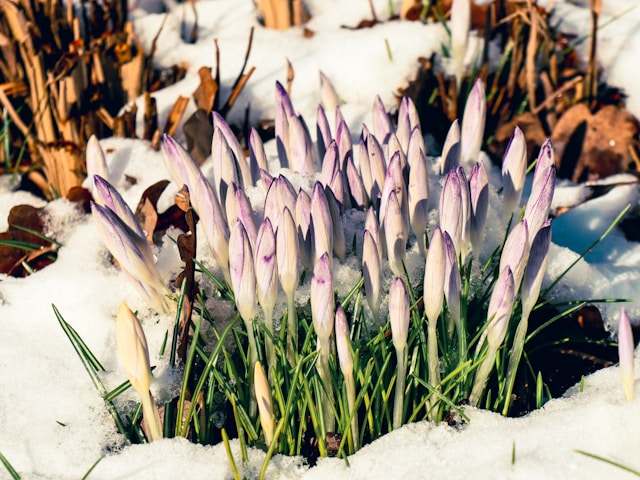
the crocuses appear, sudden and welcome
in purples and creams, flowering almond, blue squill,
red tulips, yellow daffodils and forsythia,
then masses of lilacs, white, pink, and purple,
like fireworks exploding in slow motion.
The winter’s ravens are banished by the geese.
The warblers scavenge last year’s unpicked berries,
unruly flash mobs carousing at drunken feasts.
The Northern Hemisphere turns her face to the sun
for the million millionth time, and Nature wakes,
preparing the pageant for her cast of billions,
putting on the green, sounding the fanfare.
So much drama. Maybe this time around
spring will bring us death instead of life.
A comet or solar flare might kiss our planet,
with auroras like battalions of righteous angels,
and blast it to the dust that first began it.
Glenn Wright is a retired teacher living in Anchorage, Alaska with his wife, Dorothy, and their dog, Bethany. He writes poetry in order to challenge what angers him, to ponder what puzzles him, and to celebrate what delights him.