
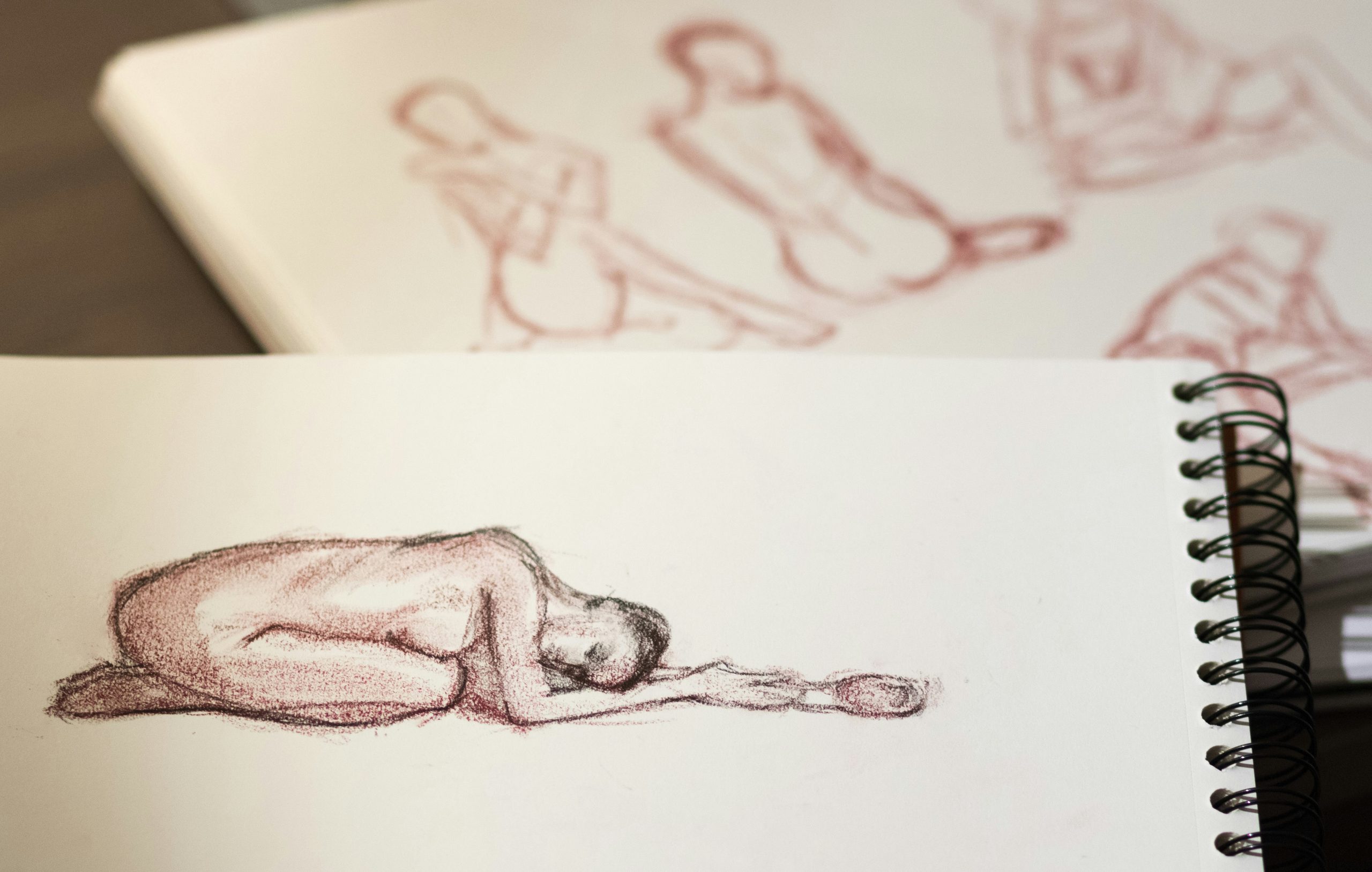
Two days a week I left my high school English class – Don Quixote and Dulcinea, Catharine and Heathcliff, and Miss Elliot, on whom I had a crush – a little early to drive to Kenyon College for figure drawing. This was my first encounter drawing the nude human form. Well, almost. Terri, a girl I was hoping to date, agreed to pose for a single session and a single drawing, reclining in a black vinyl bean bag chair in the corner of my room. Within a few minutes of scribing the page, my regard of her switched from the romantic to the analytic and aesthetic. I was in love with her, but I was more smitten with the comprehension of how to depict the female form – the desire to make an excellent drawing.
The figure drawing class was held on the upper floor of Bexley Hall, an odd, red brick gothic revival building. The students, all about a year older than me, sat on drawing “horses,” simple bench-like furniture where we leaned our drawing boards and with pencils, conte and charcoal painstakingly replicated a model’s pose on identical sheets of paper. It was an exciting time as I gained a sense of what art school might be like. The models, young, thin, work-study students, were adequate, but the poses were rarely challenging. At the outset of one session, when the usual model didn’t show up, the instructor asked another art student, a veteran of the class, to pose. With no hesitation, he stripped down and took his place. I found this more unsettling than when a model arrived for the pose in a robe. The act of disrobing made him more naked than nude. The models were often situated in a chair on top of a table. One painfully shy girl, on her first day, was so seated and after a drawing or two I noticed that her chair had shifted so that one chair leg was hanging off the edge. I could see the impending disaster but froze because if I called her attention to her peril, she would likely fall. And I was too shy to approach her. When the professor came my way, I would say something to him. But she shifted and both model and chair flipped over and off the table. Somehow, she landed on her feet. Though shaken and embarrassed, she was unharmed, but no longer keen on modelling.
The next fall, at art school, I mounted my drawing horse every Monday morning after art history, just like fourteen other eager 18-year-olds in tie-dye and ratty bell bottom uniforms. We came to know the bodies of a variety of models, and they became part of our routine. They could be seen in their robes, smoking in the hall, or getting a cup of coffee or soup from the vending machines. We all groaned inwardly and rolled our eyes at one another when Perfect Girl was the model of the day. She was beautiful. Blonde, pale, petite and flawless. For the first ten minutes of our first class, most of the boys were in love with her and the girls were embarrassed for her – for the necessity of her nakedness. But soon we discovered her perfection was impossible to draw. It was as if our pencils refused to latch onto her contours. She was like drawing mist. Equally difficult was Yoga Guy. He had a long thick beard and graying hair that extended to his waist. His poses were extraordinary and daring in flexibility, often striking headstands and other ridiculous yoga positions. However, he was so skinny that if you happened to get a side view of his pose he nearly disappeared. The results on the page were what looked like hairy sticks. And then there was The Adonis. When he shed his robe, the women in the class became particularly quiet, but everyone was in love with him. Athletic, tastefully muscular, exquisitely proportioned, his poses were dynamic and inspiring. Our drawings were exquisite on Adonis days. In sculpture class we modeled clay figurines of Curvaceous Mom. At forty-something, her body and the way she carried herself projected the confidence of a mother. For boys a long way from home, we wanted her to wrap us up in her arms (clothed of course) and tell us everything would be just fine, that we would be brilliant artists – and maybe take us home for dinner.
There were a couple of oddballs. The Exhibitionist (aka, Happy-to-See-You-Guy) was a strangely shaped, squat, balding man. The male models usually wore a typical athletic supporter purchased in a sporting goods store. This guy donned a size-too-small black leather apparel obtained from an entirely different venue. Walking past the drawing studio one morning, I caught a glimpse of him posing for another class. He flashed a creepy smile while an obvious erection strained at his inadequate covering. For painting class Bathing Beauty was integrated within an enormous and complex still-life construction in the center of the room. She couldn’t seem to sit still, the only skill required, and after an hour or so of fidgeting, lost interest in the task, wandered over to the paint encrusted sink and began splashing water on her body, rubbing her limbs and humming, seemingly heedless of her incredulous onlookers. Her new preferred pose reminded me of a Greek Venus we studied in art history. The students felt sorry for her and after a bit, the professor gently shepherded her from the room.
Years later, as a new professor, for the first figure drawing class I taught, our model Tracy was pregnant with her first child. We were all her family on Tuesdays and Thursdays as we watched her belly, breasts and ankles swell over the course of the semester, her progress charted in the students’ drawings. We threw a little shower for her, and her baby arrived a week after the final critique.
David Sapp, writer and artist, lives along the southern shore of Lake Erie in North America. A Pushcart nominee, he was awarded Ohio Arts Council Individual Excellence Grants for poetry and the visual arts. His poetry and prose appear widely in the United States, Canada, and the United Kingdom. His publications include articles in the Journal of Creative Behavior, chapbooks Close to Home and Two Buddha, a novel Flying Over Erie, and a book of poems and drawings titled Drawing Nirvana.