
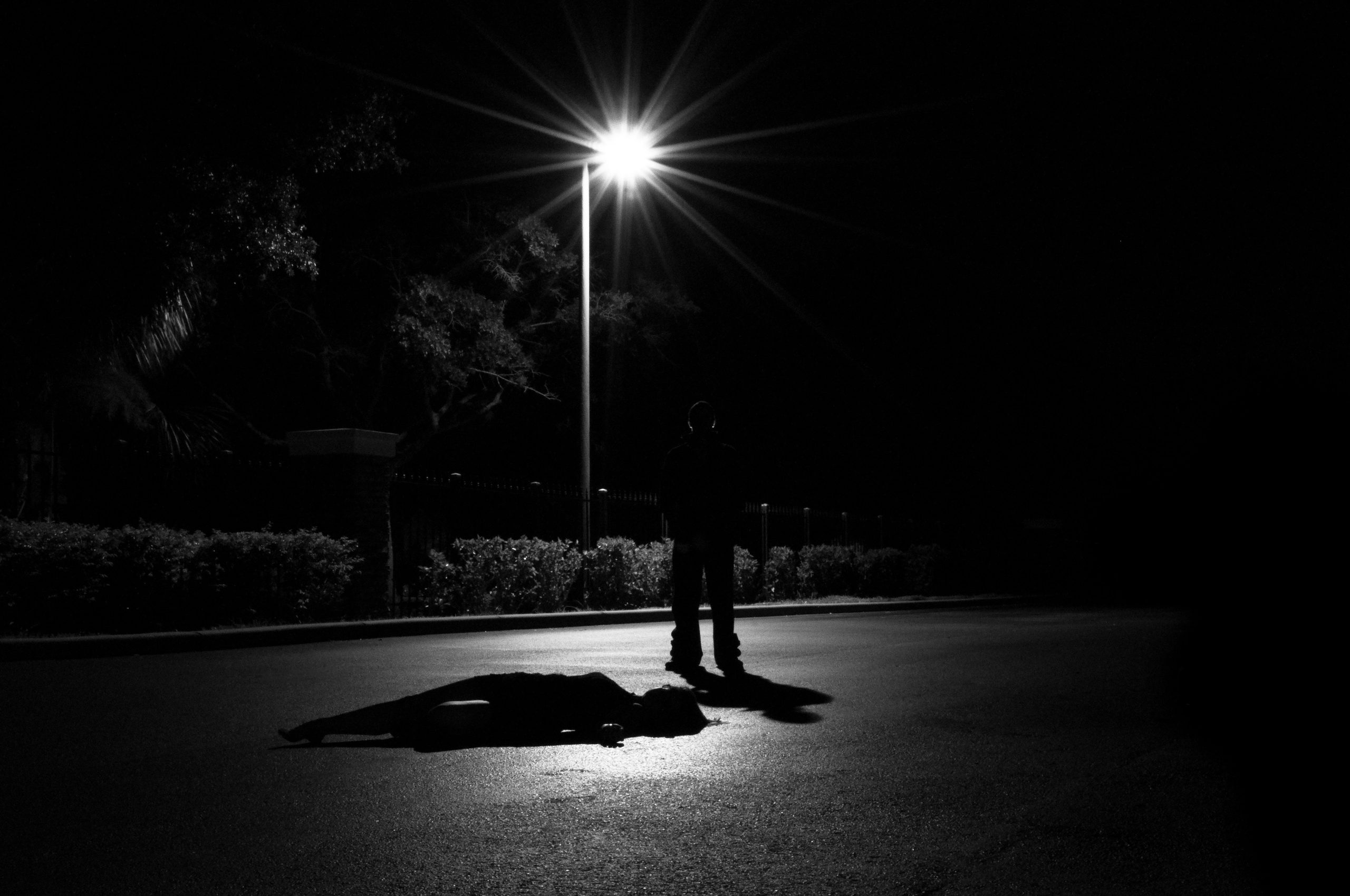
He climbed onto roofs at night to watch people through their skylights. Along the leaded ways and tiles his shadow crawled, resting behind chimney stacks or the shallow lip of a ridge. Big old Victorian buildings, really substantial, that lined the seafront, some converted to hotels or retirement homes, most of the rest split into flats. Great dark things, towering in the moon’s wash, curtained windows closed against the night and against the sliding sea worrying the promenade. Only the skylights left clear – ‘to see the stars, but never me.’
#
He was quiet, good-looking, even with his broken nose and the pale purple line worming over his chin (a shop window he’d fallen through when drunk). I’ve forgotten what had broken his nose. A heavy smoker and bad gambler. The only criminal I’ve ever known. Forty-five, younger maybe. I was young, so he seemed old… had some grey in his hair. Cheap clothes, though a good leather belt.
He did odd jobs, cash in hand. Plumbing, carpentry, removals, clearances. Anything, really. He worked a lot; he didn’t need the crime, which he didn’t seem to like doing anyway, and wasn’t any good at. He was reliable, in his way; didn’t like being late, always finished what he started. Proud of that. But, once he’d been paid, he’d stop off for a drink. Two days later, he’d wake on the beach with dried blood on his face and the wind whistling through his empty pockets.
If he’d just gone back to the next job then, quiet, broke and contrite… but he wasn’t done. He’d scrounge a loan, find a card game or some fruit machines in the arcades along the sea front, and stand there, fag in his lips, punched eye watching the spinning cherries, scuffed knuckles never quite quick enough on the button. A day of that left it worse, so he’d steal from the small shops, drinking what he got till he was bold enough to judge no risk at all. That would end when either the law or those he stole from caught him – ‘suit’ or ‘bandages’ he’d say, depending on which. ‘The only fuckin’ time I ever wear one.’ Suit, he meant, in court; he wore bandages a lot.
#
He’d go up the fire escapes, ape-hunched and silent, peeking in. He wasn’t after naked flesh. He’d just perch there, by a skylight, the darkness staring, while a family ate their dinner below. He watched whole films with couples snuggled up on their sofa while he squatted above them in the dark, his legs going numb.
#
It excited me, being with him. The way he lived. I never risked anything; I never stole or got involved in any of that. He never wanted me to. I gave him money now and then. Not that that meant anything; he was generous, too. I just liked to watch his life happen, to hang around him while it played out. The way he made a day: took a train ride or wandered up to the ruined mansion above the town on whim or just walked slowly through the park. The way he looked at life, at houses, people, at the streets they lived in… it was always different to how I looked. He seemed to see so much more. When he looked at something, it opened for him, like some offering, its ordinariness breaking and rearranging into a story or an opportunity. A stranger’s smile, a front door left open or an old man walking his dog… from these he could infer not just reasons or motives, but whole tales of how and why they’d come to happen and, also, what they might become, how the afternoon might go, if he smiled back or took a closer look behind the door or stroked the old boy’s dog and struck up a conversation. The future and the past both split and split again for him at these moments, each new way an adventure to be explored, a trail to follow, the air around it scented with mystery. These nothings that populate the average day, these for him were marvels, revelations, endless and rich. Buying a loaf of bread or strolling the promenade were points of departure for him, their potential only briefly hidden before the cracks showed and the marvellous shone through, beckoning him.
It was why I tried so hard to see things his way. And he wanted me to. To see what he saw. Only when his revelations led to him to where he thought there might be trouble would he stop me from following. I got to share the view, not the risk. I was safe, he was entertainment.
#
He’d study people’s heads. Really look at them, loved to talk about it later. Sitting in his shitty flat, describing their heads in great detail, surmising what they might be like, what it might mean to live a life with such a head. It made him laugh. If he saw a good head, he’d talk about it for days, fascinated. One of his lovers, a short ugly guy with black wire hair, had had a large head. He said that’s what had first attracted him. He’d lie in bed and stare at this guy’s head while he slept. Take in every detail. How the bone held the flesh up to the world, the folds and hollows, time’s lines in the skin, the foliage of hair, the variations in stubble. He’d follow people round town if they had a good head, dodging out of sight like he was in some cheap thriller. Head-hunting he called it.
When he spoke, he drew hard on his cigarette till his cheeks collapsed in trying to meet each other, then he’d suck all the smoke down and laugh and start talking. Never knew a man laugh so often. Gradually, the smoke would start to join the exhaled breath, his lips breaking it up, chopping it into word-sized chunks, but still it kept coming – I could never believe how much – and, when I thought it would never stop, it would weaken and fade at last, gone by the time the next laugh came.
They were normally at his own expense, his laughs. His way of hating himself, I think. An unwelcoming reminder. Like some wire fence round an unsafe structure, its barbs ragged with bits of caught plastic, only it wasn’t plastic, but all the stupid things he’d done, hung there on his smile. Why smile, each stupid tatter said, why put a smile on such a life, such a head?
For the rest, for what he said about other people, other things, about when something had gone wrong… he never blamed the drink or those who’d fucked him over. Just told his version, one that left him with a stolen flatscreen TV hugged to his chest, swaying drunk in the blue revolving light that blocked his way, his accomplices gone sooner or never showed at all. Just him, describing him, there with a stupid grin on his face in the siren-loud night. Even his silences were rueful when he told of what he’d done. Wordless breaths halfway to confession.
#
I watch them sleep. Sleep sometimes myself, guarding them. Not rats or bats or bad dreams can get them when I’m there, I think to myself. Shivering in my dreams.
#
He had an appreciation, too, about the way life should be lived which amounted to a morality of sorts. He’d work for people, see inside their houses (look at their heads), see how they’d put their worlds together. If he was impressed, he’d explain what he thought they’d done, how it made him feel. He wrapped it around himself as he spoke, taking the shape of a life that wasn’t his, a cloak he’d worn for a morning or a week, an outline he’d borrowed but knew he’d never keep. If they complemented him on his work and tried to recommend him to their friends, he wouldn’t make much of it to me afterwards, talking only about what they’d done right. Its shape, the way it never fitted him.
There was a guy he worked for, on and off, almost a year, an artist who had a real thing for him. Eventually, the artist persuaded him to move in, offered to pay him to model. Paid all the other bills as well; after a few weeks, the artist even said he loved him. Then the card games came and the lost weekends became… He gave him a painting, though, a portrait. It showed him at an open window, looking back towards you, standing in jeans but no shirt, where the artist had put him, on a day between jail and beatings, a skin of shadows but no bruises, a smile just arriving between his broken nose and the scar on his chin, his eyes brighter than the morning light behind him from the window he might have been leaving from, or just come through. A memento.
#
He nearly jumped once, he said. Nothing wrong, but the light was so bright it made the air thicker, made it something that would take you and let you down, gentleways, onto the shore below. He stood with a world of brick and slate behind him, one of sea and light in front, a shadow in its elements, caught between the two.
#
He had strange hobbies, fleeting, almost debilitating crazes. He tried breeding huskies, a whole team’s worth, in a tiny flat with no garden. He wanted to make a friend’s old shed into a mini cinema; he spent months working on it, till the friend moved. He knew a bloke who brought reclaimed building materials back from France to sell to middle-class people gentrifying their properties. He’d buy anything the bloke couldn’t shift, odd bits, the leftovers really, but he’d get attached to them, see them as essential for some great scheme he was planning. Ended up with a couple of storage containers full of them, till he couldn’t pay the container rent and the contents got taken in lieu. He tried nightline fishing, to supply the seafront restaurants; dawn would find him snoring on the low-tide shore, a bag of empty cans beside him, while gulls picked at the lone flounder or bass left by the tide to die on his line.
#
Quite often, they were empty, the places he peered into. Just the shapes their owners left of themselves when they went out. One light left on or a bright moon carving a table edge from the dark, a chest of drawers or wardrobe thickening that darkness further off, the roll of a bath’s smooth white on tile shine. Pale floor space, dropped clothes, unwashed cups, a thousand objects waiting. Paintings, photos, faces propped, staring out, some up at him where he was kneeling, staring in.
#
He was always getting hurt. Not only with drink. He got hit twice by cars when I knew him. Just crossing a road in the middle of the day, no reason for it. He fell down and up the same set of stairs on the same day, breaking a sober bone each time. The hospital couldn’t believe it. He fell off the promenade, for fuck’s sake, the one that tottering pensioners managed not to fall off every day of the year. Just lay there on the shingle below with a broken wrist and a baffled grin unsurprising his face. Hadn’t touched a drop. He, who strode rooftops in the dark, a hundred feet up.
#
The car was the thing he most often came back to when he was drunk. I can’t remember how he’d got it, but it was legal, powerful, the best he’d owned. He was living with a guy at the time and they took it on holiday. Drove the lanes and valleys, stopping at beauty spots, picnicking, loving, lying naked in the sun, the car gleaming beside them. The best car, best love, best time he ever had, he said.
Went out drinking not long after they got back. Ended up at a card game. Lost and lost, till the car was all he had left. Always stopped at this point when he was telling me, as if coming to the moment for the first time – the moment when he leaned back in his chair at the table and said quietly, sober as only a drunk can be, “I bet the car” – the car he’d been telling them about all evening, had even shown them during a break in the game. He was back at that table when he told it to me, but sitting opposite himself, staring hard at his own quiet, drunk, determined face, watching his own slow and steady hand reaching to his pocket, drawing out the keys and laying them ‘without a sound’ on the table in front of him. That’s when he’d pause, between smile and sneer, his head giving a slight shake as he watched himself, all those years ago, leave the keys and lay down the cards that would take them from him. He couldn’t not tell it, sometimes, when he was drunk and we were alone. Offered it up, again and again, proof and verdict, all that he couldn’t fathom in the crime of himself.
#
Got caught in the end. Foot through a weak spot, a cracked tile below the lead, that took his angel’s tread. When they couldn’t prove he’d stolen anything, the police cautioned him. He left it one week, left it two, till a sharp moon showed him the pier and wave’s ivory crests and the pebbles shining on the shore below the big buildings gathered like castles, their little folk all asleep within. Not all, some were waiting for him when he came back down.
#
Inside, now and then. Short stretches, though, open prisons, small beer. That last autumn I knew him, he finished one, came out looking better, healthy. Soon working again, long days clearing a warehouse. Good money. Too good. Pay day saw him grinning.
I went round three mornings after to find him beaten. Hadn’t been to the hospital in case it got back to his probation officer. His face looked bad, lip split, a tooth gone, swollen cheek, the gouge beneath his hairline scabbing, one eye’s magenta purse closed tight, bulging like a plum. His shoulder, a rib or two; it hurt when he breathed. Some blood from inside. He couldn’t make a fist. He’d taken painkillers and had a beer on the go. He stank of shitty pubs and old sweat and a meat smell, close and choking, his breath staling even the beer. Wouldn’t eat and couldn’t remember much. Winced when he coughed. There was a weariness, too, something I’d not seen in him before, even when he was bad. He looked as if the miracles had suddenly gone from his every day, vanished, leaving in their place only this ordinary, relentless repetition.
I got him to take a bath, partly to get rid of the smell, partly to see if there was anything else broken. It took ages to strip him, every angle asked of his body revealing a new pain. He seemed ashamed, cowering, naked in his inability. He finished his beer and had to gulp another down before I finally helped him into the water. Slowly down. Slow.
He started to cry. Soft, no effort in it, the tears from his swollen face dripping into the water. There were bruises on his back and chest and up his arms, a few on his legs. Half-curled, he seemed so small. Weak and old. I tried to get him to lie back, but he wouldn’t. Just sat quiet, his head bent, crying, the smell rising with the bath’s heat. His lip opened again, each red drop spreading as it hit the water. I took the flannel and soap and started to wash his legs first because they seemed the least bruised. He let me, even trying to lift his foot so I could wash it, but he was still crying when I got to his back, and I had to go carefully between the livid marks.
Craig lives in the UK, writes a bit, reads a lot and stares out of windows into the middle-distance even more. Sometimes, some of this helps.