
Eliana changed her route after she saw a man in the second row snort heroin on the Chicago bus. She complained to her parents about the unpredictable odors and sounds, so they suggested she take the Division bus instead. This bus moved slowly. The Clybourn Bridge clogged up traffic on Division Street and the bus stopped often for women with babies in strollers to board. Eliana ran late every day that summer. She always planned an early start, but she woke exhausted. The house was empty, so she clung to her bed, ignoring the cracker crumbs brushing up against her skin, dozing from seven to ten in the morning. On the bus, she scrolled on her phone, avoiding the gaze of fellow passengers and candy sellers.
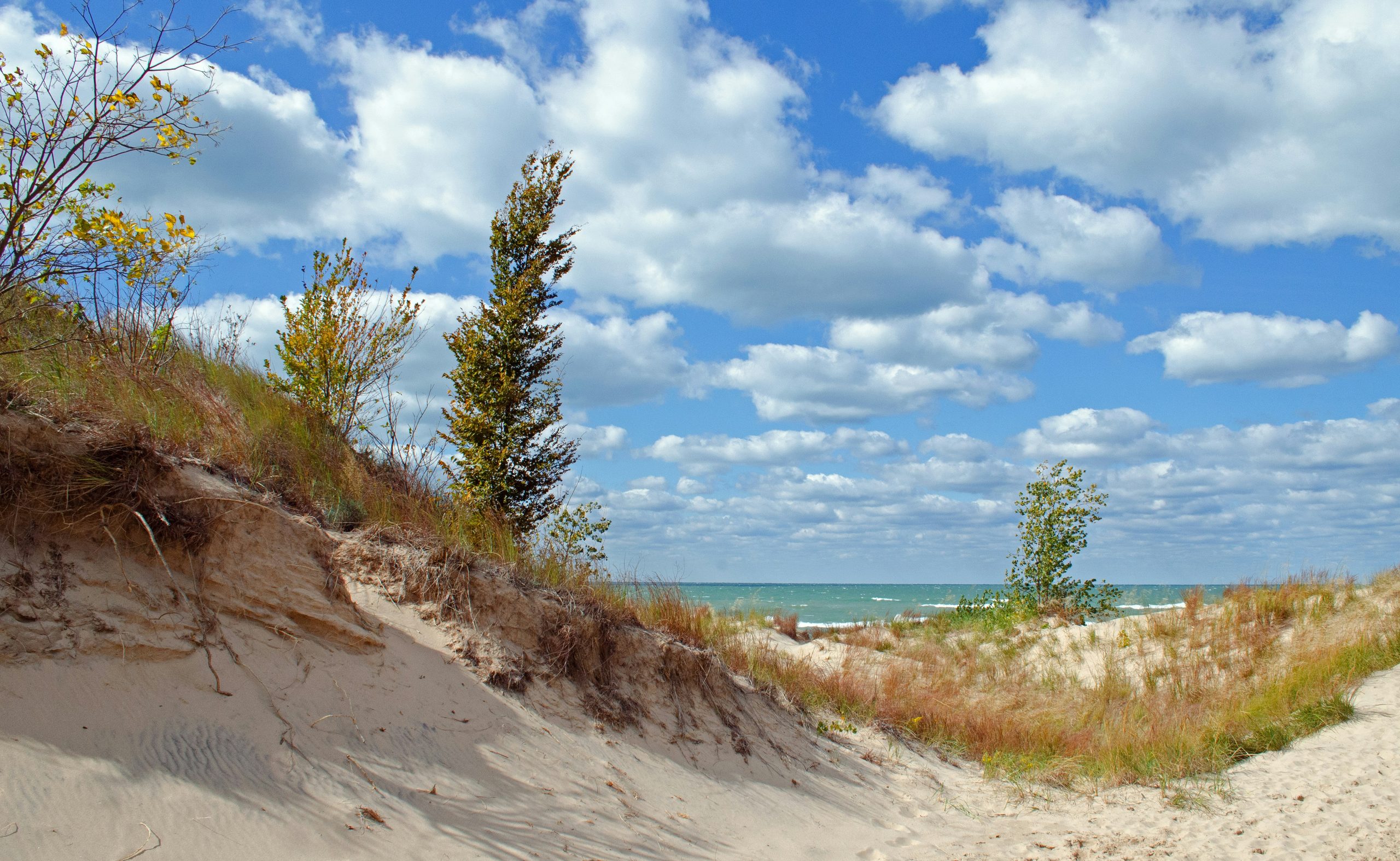
By the time she arrived, usually around eleven, the sand had absorbed the heat and the air particles vibrated with warmth, oppressing the body with heat from below to match the heat from above. Eliana put her bag in a public locker, secured it with her own padlock, and walked to the water as she adjusted her cap. The heat made her torso expand, as though she were a balloon filling with hot air.
Lake Michigan was always cold, and the shock made her forget the humidity, until she raised her shoulders and back and chest to the surface and felt the sun strike her skin. The UV rays hit her with small pellets on her upper shoulders, burning as though they would leave blisters. Then the Lake Michigan cold pressed on her body full force, pricking her all over, until she relaxed and her spine elongated. Eliana let the water caress her inner thighs, her armpits, her cheekbones, as though she was being covered in kisses.
After her mile swim, Eliana scanned the beach. It was a Tuesday, so it was filled with teenagers and tourists trickling in from Navy Pier. “And the unemployed,” her father liked to say. She had made friends the week before at a pick-up volleyball game. They needed an extra player. They were caricatures: tall and muscular, all-star teenagers, with American names, like bold colors: Tyler, Dwight, Jamal, Josephine, Destiny… she couldn’t remember the rest. Individually, they had different features, but together, they blended into the same amorphous person.
Eliana was too shy to ask for their Instagrams or Snapchats or numbers, so she hoped that she would run into them. Now she didn’t recognize any of the groups on the beach. She lay down to let the sun evaporate the water off her body. Maybe they would arrive if she waited. Her muscles relaxed and expanded, her shoulders and arms and back grew larger, thicker, broader, and then she settled into her body. The sun dried her skin and bathing suit. Eliana propped herself up by her elbows and started playing a game. She stared at the young men her age coming in and out of the water, walking on the beach, and imagined what they were thinking.
Were they looking at her or were they ignoring her? Did they notice her at all? She didn’t even wonder if they found her attractive. She just wanted to know if they saw her. That possibility filled her with a mix of dread and thrill. Then she thought, no, they don’t notice me at all. But often, she allowed the possibility that they watched her covertly, wanting her from afar. But if that was the case, why was it secret? Why didn’t they speak to her? Was she odious?
“Hey, how are you?”
Eliana followed the sound of the voice and looked behind her shoulder. A young man, a few years older, wearing Ray-Bans and a crisp white T-shirt stood a few feet away.
“Hi.”
“It’s hot, isn’t it?”
“Yes.”
“What’s your name again?”
“Eliana.”
He sat down next to her. He must have been one of the players from last week. Tyler, or maybe Carson. Eliana was too embarrassed to ask again.
“Where do you live?”
“Humboldt Park. You?”
“Schaumburg.”
He had arrived by Metra and taken the bus from Union Station to Navy Pier. Eliana learned he was a waiter at an upscale Italian joint for the summer. He had plans to move to the city once he graduated college. He asked her what living in Humboldt Park was like, what her parents did, if she’d seen any shootings or carjackings. He asked her where she went out. River North? West Loop? Gold Coast? He asked her how many times she’d gone to Lollapalooza.
Eliana was breathless. She had rarely been asked a series of questions in this way, rapid-fire and pointed. Most people in her life already knew everything about her. He held his gaze intently, he nodded, he chuckled, he smiled. Eliana sat there, aware of her one-piece bathing suit and grew self-conscious about the goggle marks on her face. He asked what she was up to that day. She shrugged and smiled. He suggested they go to the Lincoln Park Zoo.
“I should get your number,” said Eliana and handed over her phone. She saw her type in his name: Kyle.
Eliana and Kyle boarded the Sheridan bus. It was crowded, so she sat towards the back next to an older woman while Kyle found a spot by the back door. Eliana put her headphones in and opened her phone. She scrolled by footage of clubbing in Ibiza, young women applying makeup and speaking about their finance jobs, pregnant women getting manicures and shopping, energetic influencers at their photoshoots for brand deals, elegant models sipping spritzes and ranting about broke men, and backpackers eating fried scorpions in Thai street markets. While these women did not feel real, but instead images in motion, like GIFs or paper dolls, they nevertheless imprinted on her throughout the day. To watch these women was to suspend time, to make summer endless, even as the clock whirred and each day slipped by, watching these women stretched Eliana’s day into something endless.
At their destination, Kyle fumbled opening the back door, so Eliana stepped in and placed her palm by the sensor.
“Are these doors broken or something?”
“You’re just a suburban kid,” Eliana teased.
The curdling heat created a persistent whine from the hoards of children. Eliana and Kyle walked through tantrums, exasperated parents, melting ice creams, iced lemonades, a couple of lions napping, grim gorillas, and lethargic polar bears. Kyle grew agitated and bored. He wanted to rent bikes and ride along on the Lakefront Trail. As they cycled, they passed by the thumps from portable speakers, the whirr of jet skis, and people lounging on the concrete beach and diving into the rocky waters.
They stopped at Montrose Beach. Kyle had been texting some friends. They walked up to a group of four young men, all similar looking, with curly mops of hair. Two wore Oakley sunglasses. Kyle introduced Eliana. The skinniest one handed her a warm Modelo. Eliana watched one young man, shirtless and wearing jeans, lick a rolling paper and delicately assemble a joint. After some pleasantries, they started speaking in a confident drawl about their side hustles, which they called businesses, their sales internships, fraternity socials, family vacations to the Wisconsin Dells, spring breaks in Florida, and a general disdain for national politics.
“Both sides are bad,” said Kyle.
“That’s not true! One is actively hurting my family and friends,” cried Eliana.
The boys asked Eliana what she did. For work, or school, or fun. Eliana shrugged. She mumbled something about taking an online prerequisite class. Kyle bought the group ice creams from a paletero that wandered by. Eliana licked her ice cream and hit the joint in silence as the boys resumed their conversation.
Once again, the lake called to Eliana, and she decided to go for a swim. The water here was deeper and colder than at Ohio Street Beach. The lifeguard rowed his boat about two hundred feet from the shoreline, whistling at any swimmers that swam too far from the shore. To the south, the downtown skyscrapers looked like little toys. Legos. Eliana, suspended in the water, looked at the minutes and hours stretched before her as though they were a pile of coins. She didn’t want to spend these coins, she wanted to hoard them, and then savor them, spending them one by one in a frugal manner. If one minute was one coin, she could live in that minute, looking at all the ridges and etchings in the coin, letting the seconds of time settle on her body, accumulating on her skin like bubbles. Eliana floated, tread water, and waded for what felt like hours, but then again, could’ve only been twenty minutes. She wasn’t sure and that made her dizzy. She emerged from the lake. Kyle was still there, sitting with his friends, their faces were shining and their eyes were glazed over from the weed.
“I lied earlier,” said Eliana. “I dropped out of college. Or maybe I’m taking a break. I’m not even working. My parents think I’m useless.”
“Parents can be a real drag,” said Kyle.
“Fuck it. You’ll figure it out. Just charm your way into some restaurant gig and meet some cool people. Take a breather,” said the weed roller.
“Maybe I should be an influencer. But I’m scared of being watched.”
“We should all be influencers. That’s the only way we’ll be able to afford a house,” said Kyle.
Eliana took out her phone and started taking photos and videos of the boys, of the groups on the beach, of the water. There was a gap between what she envisioned in her mind’s eye and the result on her phone that made her stomach ache. The images on the screen were not as beautiful as reality. They failed to capture the breeze, the smell of the wind and the lake and beer and weed and garbage, and the dizzying power of the sun.
The boys were outstretched, lying on their backs and sides and dozing, not paying any mind to her documentation. Bodies, she thought, were just outstretched muscles, bags of bones, tendons, tissues, all connected in a jumbled mass. Eliana started closing her eyes and snapping photos. She opened them. Time slowed to a drawn-out loop, undulating, stretching, and assembling into different shapes and masses. She was both a container and an opening.
Eliana gathered her things. “See you around, okay?” Kyle waved goodbye. As she walked to the parking lot each heartbeat corresponded to one second on the clock. One heartbeat, two heartbeat, three heartbeat, four. And on and on and on.
Tanya Kornilovich has been published in Necessary Fiction, The Weightless Review, Scapi Magazine, The Alliance for Jewish Theatre, and elsewhere. Her nonfiction essay was a runner-up in The Mukoli Contest. She is a storyteller and has read at Tuesday Funk and Do Not Submit. She lives in Chicago after a nomadic childhood in Russia, the UK, Germany, California, Oregon, and Ireland.